Quick answer: A walk-in cooler not cooling usually comes down to one of eight problems: a wrong setpoint or failed control, no power to the condensing unit, a door that is not sealing, blocked airflow inside the box, a dirty condenser coil, an iced-over evaporator, a failed fan motor, or low refrigerant. You can check the first four yourself in about ten minutes. The last four need a commercial refrigeration technician.
At Local Refrigeration & HVAC, we have spent more than 17 years answering walk-in calls across Dallas–Fort Worth from our shop in Wylie, Texas. North Texas is hard on walk-ins: from May through September, condensing units on roofs and back slabs fight 95°F-plus afternoons, while lunch and dinner rushes push warm, humid air through the door again and again. Equipment that barely kept up in spring is often the walk-in cooler not cooling by July. This guide walks through the causes of a walk-in cooler not cooling in the order our technicians check them.
First, Protect Your Product
Before troubleshooting, take care of the food. The Texas Food Establishment Rules require cold-held food to stay at 41°F or below, so time matters.
- Keep the door closed as much as possible. A closed walk-in holds its temperature far longer than one being opened every few minutes.
- Write down the box temperature and the time, then check again every 30 minutes.
- Move your most valuable or most sensitive product to a working reach-in or freezer if you have one.
- If the box is already above 41°F, call for service now rather than after troubleshooting.
For a breakdown of what a failure can cost, read what a walk-in cooler failure really costs a Dallas restaurant.
Walk-In Cooler Symptoms and Likely Causes
| What you notice | Most likely cause | Can you check it? |
|---|---|---|
| Box warm, compressor and fans silent | Tripped breaker, disconnect off, safety switch tripped, or failed control | Yes, once |
| Box warm, everything running | Dirty condenser, low refrigerant, or door leaking air | Partly |
| Ice on the evaporator coil inside the box | Defrost failure, door not sealing, or evaporator fan stopped | No — call a tech |
| Box warm only in the afternoon | Dirty or boxed-in condenser losing capacity in the heat | Partly |
| Water on the floor under the evaporator | Frozen or clogged drain line, often from a defrost problem | No — call a tech |
| Compressor short-cycling on and off | Control problem, low refrigerant, or high-pressure trips | No — call a tech |

Walk-In Cooler Not Cooling? 8 Common Causes
1. The setpoint was changed or the controller failed
Start with the simplest check. Walk-in coolers are usually set between 35°F and 38°F. Make sure nobody bumped the setpoint, that the controller display is on, and that the system is not simply in a scheduled defrost. A box that warms a few degrees during defrost and recovers afterward is normal. A controller with a blank screen or one that never calls for cooling needs service.
2. The condensing unit has no power
If the compressor and condenser fan outside are silent, check the breaker and the disconnect switch next to the condensing unit. Some systems also have a high-pressure safety switch that trips when the condenser overheats. Reset a tripped breaker or switch once. If it trips again, stop and call a technician — repeat trips usually mean an electrical fault or a condenser that cannot shed heat.
3. The door is not sealing
A torn gasket, a door closer that no longer pulls the door shut, a sagging hinge, or a strip curtain that has been tied back lets warm, humid air pour in. Close the door on a dollar bill at several points around the frame; if it slides out easily, the gasket is not sealing there. Look for frost or condensation around the door frame, which is another sign of an air leak.
4. Airflow inside the box is blocked
Cases stacked tight against the evaporator, or a big delivery loaded in all at once, can choke the airflow the coil needs. Keep a few inches of open space around the evaporator and avoid packing product to the ceiling. Warm product also adds a heavy load, so let the box recover after large deliveries before judging whether it is really failing.
5. The condenser coil is dirty or boxed in
This is one of the most common causes we see in North Texas. The condenser coil releases the heat pulled out of the box, and when dust, grease, and debris coat it, the system cannot get rid of that heat. Screen walls and tight equipment yards make it worse by trapping hot discharge air so the unit breathes its own exhaust — see why a boxed-in condenser keeps your cooler warm. Coil cleaning is part of every maintenance visit for exactly this reason.
6. The evaporator coil is iced over
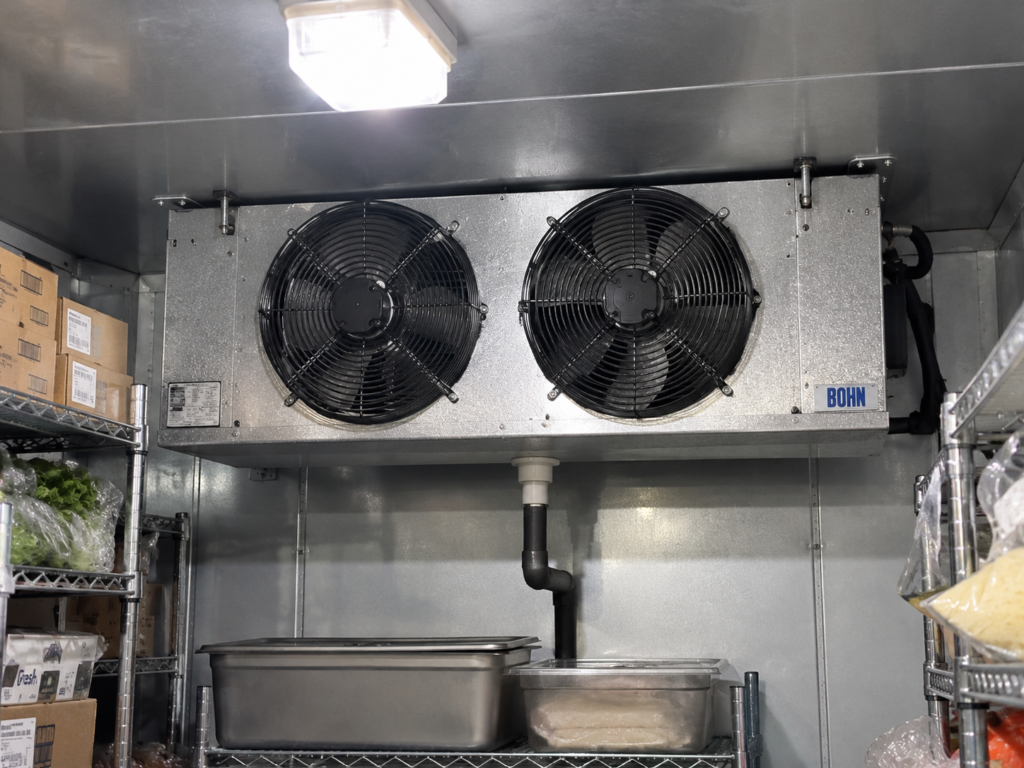
Look at the evaporator inside the box. If it is covered in solid ice, air cannot pass through it and the cooler warms up even though the system is running. This usually points to a failed defrost heater, timer, or termination sensor, a door that is not sealing, or a stopped evaporator fan. Do not chip at the ice — it is easy to puncture a coil. Turn the system off, let the ice melt, and call for repair so the underlying defrost problem is fixed.
7. A fan motor has failed
Walk-ins depend on two sets of fans: evaporator fans inside the box that move cold air, and condenser fans outside that remove heat. If either stops, cooling drops fast. Listen for the fans, and look for blades that are not turning, are blocked by ice, or turn slowly. Fan motors are a common, relatively straightforward repair for a technician.
8. Low refrigerant, a compressor problem, or an electrical fault
If the setpoint, power, door, airflow, coils, and fans all check out, the problem is usually inside the refrigeration system: a refrigerant leak, a failing compressor, or a bad capacitor, contactor, or pressure control. Federal EPA Section 608 rules require refrigerant work to be done by a certified technician, and these repairs need gauges and electrical testing. Signs include oily spots on refrigerant lines, a hissing sound, or a compressor that clicks but will not start.
Walk-In Cooler Not Cooling: What You Can Safely Check in 10 Minutes
- Read the controller: confirm the setpoint and that it is not in defrost.
- Check the breaker and the disconnect at the condensing unit. Reset once only.
- Listen for the evaporator fans inside and the condenser fan and compressor outside.
- Check the door: gasket, closer, and strip curtain. Try the dollar-bill test.
- Look at the evaporator coil for heavy ice and clear any product blocking it.
- Look at the condenser outside for heavy dirt, debris, or anything blocking airflow.
If you have done these checks and you still have a walk-in cooler not cooling, or you found ice on the coil, a compressor that will not run, or a breaker that keeps tripping, it is time to call a technician.
When to Call a Technician for a Walk-In Cooler Not Cooling
- The box is above 41°F and still climbing.
- The evaporator coil is iced over, or ice comes back after it melts.
- The compressor will not start, hums, or trips the breaker again.
- You hear hissing or see oil on refrigerant lines.
- Water keeps pooling under the evaporator.
- The cooler only struggles in the afternoon heat, week after week.
Our technicians handle walk-in cooler and freezer repair 24 hours a day, 365 days a year across Dallas–Fort Worth. We are licensed and regulated by the TDLR (#TACLA109085C), work only on commercial equipment, and service all makes and models. Call (972) 412-8300 any time.
How to Keep It From Happening Again
Most walk-in breakdowns start small. Quarterly maintenance — monthly for high-volume kitchens — catches problems before they leave you with a warm box: condenser and evaporator coils cleaned, refrigerant charge checked, defrost verified, gaskets and closers adjusted, drain lines cleared, and temperatures logged. Scheduling a visit before the summer heat arrives is the single best way to avoid a walk-in cooler not cooling in the middle of a North Texas summer. Learn more about our commercial refrigeration services in North Texas.
Frequently Asked Questions
Why is my walk-in cooler running but not cooling?
If the compressor and fans are running but the box stays warm, the usual causes are a dirty condenser coil, an iced-over evaporator coil, low refrigerant from a leak, or warm air leaking in around the door. A running system that cannot cool means heat is not moving out of the box, and a technician should check pressures and airflow.
Why does a walk-in cooler freeze up?
A walk-in cooler freezes up when the evaporator coil collects more frost than the defrost cycle can clear. The most common reasons are a failed defrost timer or heater, a door that does not seal and lets humid air in, low refrigerant, or an evaporator fan that has stopped. Turn the unit off, let the ice melt, and call for repair.
How long should a walk-in cooler defrost cycle last?
Most walk-in cooler defrost cycles finish well within an hour, and many take 20 to 40 minutes, depending on the system and the controller settings. If the box warms during defrost but recovers afterward, that is normal. If it stays warm long after defrost ends, or defrost runs constantly, have the controls checked.
Can a dirty condenser coil stop a walk-in cooler from cooling?
Yes. The condenser coil releases the heat the system pulls out of the box. When dust, grease, or debris coats it, or when it is boxed in by a screen wall, the system cannot shed heat, pressures climb, and cooling drops. This is especially common in North Texas summers, when outdoor temperatures regularly pass 95°F.
Should I reset the breaker if my walk-in cooler stops?
You can reset a tripped breaker or high-pressure switch once. If the walk-in trips again, leave it off and call a technician, because repeated trips usually point to a failing compressor, a shorted fan motor, or a dirty condenser causing high pressure. Resetting it over and over can turn a repair into a compressor replacement.
How long does a walk-in cooler last?
The insulated box, panels, and door often last 15 years or more with care. The refrigeration system, meaning the condensing unit and evaporator, commonly runs about 10 to 15 years, depending on maintenance, heat, and how hard it works. In hot climates like North Texas, regular coil cleaning makes a big difference in lifespan.